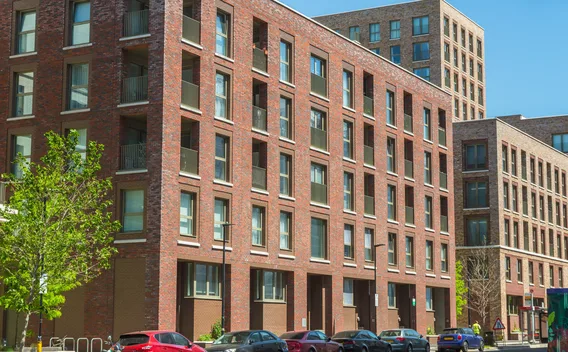
Commercial Property Insurance in Salt Lake City, Utah
The wall that closes a Salt Lake City storefront is not reliably a wall its owner paid for. The oldest leasable brick here stands in continuous main-street runs with its top few feet overhanging a public sidewalk, and when an earthquake in this valley last put a shopping street out of use, at the western end of it, the street closed along its whole length rather than building by building. What an underwriter is working out at an address here is how much of the rent depends on parcels its owner has no say in.
Nate Jones is a CPCU-designated insurance broker and the founder of Wexford Insurance, LLC and Lessors Risk Guard Insurance. He places lessors risk and
commercial property coverage for owners who lease buildings to commercial tenants,
through a specialty panel writing in 48 states.
Reach him through the quote form or call 317-942-0549.
Last updated · Reviewed by Nate Jones, CPCU
The building stock
Grid-platted downtown of mid-rise office and mixed-use blocks, with older brick and unreinforced masonry commercial buildings along historic main-street corridors.
Compact numbered-grid downtown core ringed by arterial commercial corridors and valley-floor suburban office and industrial campuses.
What the weather and the ground do here
Wasatch fault seismic exposure dominates; winter snow loading and wildfire at the bench interface add seasonal concern.
Weight is the variable an underwriter keeps returning to here, and it is not a fixed property of a building. What the ground under a valley-floor slab does when it is shaken depends heavily on how much load is standing on it, so a lightly loaded structure and a heavily loaded one on identical ground are not the same risk — which puts the tenant inside the site question rather than beside it. Racked storage, heavy plant and a mezzanine stacked to the roof all change what the ground is being asked to hold. Then the season adds a load of its own. A roof carrying snow is a heavier roof, and mass is precisely what an earthquake has to move, so one address is not quite the same structure in July as in February — and a question about what is standing on the roof is a structural question rather than a housekeeping one.
Brick standing over a public sidewalk on the parcel beside yours, set against a loss that begins somewhere you have no standing to inspect. A commercial street shut along its whole run, set against cover that turns on access rather than on damage. A roof carrying its winter load when the ground moves, set against earth movement and snow being bought under different terms. Level valley ground beneath a heavily loaded floor, set against what a tenant’s use does to the site question. And a suite gone dark while the rest of the address stays let, set against rent that stops with no repair to wait on. Taken as pairs in that order, under a closing line about who an order to shut a street is addressed to.
What sits around a Salt Lake City building
What it becomes once a claim is open
Brick over a public sidewalk on the parcel beside yours
A loss that begins where you cannot inspect anything
A commercial street shut along its whole run
Cover that turns on access rather than on damage
A roof carrying its winter load when the ground moves
Earth movement and snow, bought under different terms
Level valley ground under a heavily loaded floor
What a tenant’s use does to the site question
A suite gone dark while the rest of the address is let
Rent that stops with no repair to wait on
An order to shut a street is addressed to nobody in particular.
What the valley, the winter and the next parcel put on the rent.
The local law that binds you
Everything above this line is geology and weather. It can be priced, some of it can be transferred, and no owner alters any of it. What the City sets out here is the one item in the whole account that moves when somebody decides it should, which makes it the cheapest thing on this page to get right and the most uncomfortable one to be found wrong on. It is uncomfortable in a particular way for an owner who leases rather than occupies. What the City describes turns on the condition of the building, and an owner who leases is the party least often standing in front of it. What a resident would notice within an afternoon reaches an absentee owner through a property manager, through a tenant who has stopped calling, or through nobody at all — so the physical state of an address can change without the person holding it hearing anything about it. The item itself is small. The distance between the owner and the item is the whole of the problem.
Vacant and Boarded Buildings
If a building is not properly secured — lacking intact windows, doors, or functioning locks — it must be boarded and registered with the City unless those issues are corrected within 10 days of Notice.
The words quoted come from the City’s enforcement page rather than the codified text of Ch. 18.48, which could not be retrieved. The trigger as described is a failure to secure the building, not vacancy on its own.
What a property form does once space stops being used is a Utah question rather than a municipal one, and in this city space can stop being used with no leasing decision anywhere behind it. A tenant who cannot get customers to a front door leaves for reasons that have nothing to do with the condition of the premises, and a suite emptied because a block was shut sits idle in the same way a suite emptied by a failed business does. The wording does not sort them. It reacts to the fact of the space being unused and not to the reason it became unused — which is why the reason governs everything else on this page and stops governing anything here.
We did not find a standard fire policy printed in Utah’s insurance
code. That is a limit on what we searched, not a finding that no such
provision exists — so treat your own policy’s vacancy condition as the
operative text, and read it before a unit goes dark between tenants.
The statute and the exact words where there are any, together with whatever the
research recorded, are on the
Utah page.
Retail here is largely the continuous main-street run: a single frontage in a row of them, a parapet standing over the public sidewalk, and an owner on either side whose upkeep never appears in your file. Office splits between the numbered grid downtown, where a mid-rise floor plate and an older brick upper floor over a shop are both called office and price nothing alike, and the valley-floor campuses out toward the interstate corridors, which are newer, lower and standing on the flattest ground in the county. Mixed-use is the most recent of the three and the most locally particular: the large redevelopment that has gone into the old warehousing ground has put a habitational component into a district drawn for freight and distribution, among buildings whose neighbors were never meant to have anybody sleeping in them.
A policy is assembled out of parts that were drafted separately and get read separately once something has happened. Each page below takes one of those parts and follows where its edges sit, because a single event in this valley is rarely settled inside just one of them:
I have no say over the old brick building next door. How much of my exposure is standing on it?
The top few feet of it, chiefly. A parapet is the top of a wall with nothing bracing it, and the state’s own geologists make the point that one coming off a neighboring building can land on a building that performed perfectly well. On a continuous main-street run your frontage is within reach of the parcels on either side. So a survey of your own structure answers half the question, and the other half is about somebody else’s upkeep, which no report you commission will ever reach.
If my building comes through an earthquake undamaged, can I still have a claim?
That is a likelier shape of loss here than most owners expect. The clearest commercial example this valley has produced was a whole main street taken out of use at once, at its western end, rather than a scatter of individually damaged buildings. When access to a block is withdrawn, a tenant stops trading whether or not their own premises were touched. Property forms generally handle that through narrow extensions tied to an order of civil authority or to lost ingress, each with its own trigger and its own limit, and each worth pricing deliberately.
Does snow on the roof have anything to do with the earthquake exposure?
It changes the weight, and weight is what an earthquake acts on. The city’s design criteria for new construction fold part of a loaded roof into the mass a structure has to be designed to shake with, which is an unusually direct municipal acknowledgment that the two hazards here overlap in the same months. On an existing building it turns into an upkeep question instead: what is standing on the roof, whether the drains run, and who is going up there in midwinter when the floor below is between tenants.
I have heard the city helps pay to strengthen brick buildings. Would that reach mine?
Not that program, and the reason is occupancy rather than construction. The city’s masonry grant is written for people living in the home being strengthened — owner-occupied, inside the city, and income-qualified — so a building held as an investment or let to a tenant falls outside the eligibility before anybody looks at its walls. That grant is elective rather than compulsory, and as things stand it is closed to applications with a waiting list behind it. It is misreported often enough that owners arrive at a renewal assuming it applies.
My building sits on the flat valley floor. Is that better ground or worse?
Flatter ground changes the failure rather than removing it. Where the floor of the valley is essentially level and the soils beneath it lose strength, the state’s mapping describes the mode as a loss of bearing under the structure, and it is explicit that a light building may be untouched where a heavy one on identical ground is severely affected. Where the ground has even a slight fall toward the Jordan River, the mode changes to the ground spreading sideways instead. Which of those you hold is set by the site rather than by the building.
A suite of mine is going dark between tenants. What is particular about doing that here?
The winter, mostly, and who is left to notice things. An empty suite sits in a building that still has to be climbed onto after a storm, and the person who used to report a blocked drain or a door that no longer latches was the tenant. So the working list is who walks the building, who clears the roof, who holds keys, and who will be first to see the next thing go wrong. What is particular here is that the list falls due in the months when getting onto a roof is itself the hazard.
Sources
Two offices, holding two different kinds of record. The municipal link is where the passage quoted above is published and where a change to it would surface first. The Utah insurance regulator holds the standing record of who may write a policy in this state, and of an individual producer’s license.
Your Salt Lake City exposure does not stop at the lot line
A useful first pass at a building here covers what the walls are, what is standing over the sidewalk on either side of you, what the ground under the slab is doing, and whether any part of the address is unlet right now. Where nobody has actually looked, say so — the buildings in this valley that surprise their owners are the ones nobody ever had a reason to inspect.