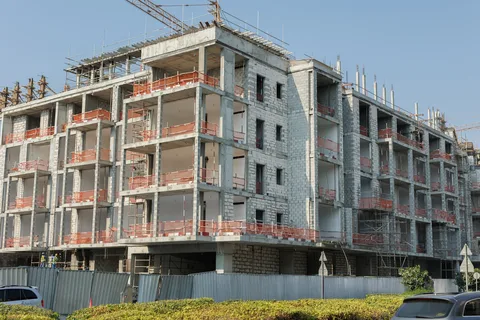
Underwriting a Houston building starts with water and with the absence of a zoning map. Which bayou watershed a parcel drains toward says more about how it has behaved in a bad year than the address does, and what may lawfully happen in the bay next door is a question about recorded restrictions on the title rather than a land-use category. Both land in the placement before anyone opens a rent roll. Underneath them sits a third thing owners rarely raise: the ground here is not a fixed datum, so a site’s standing relative to the water that must leave it is not settled for good.
Nate Jones is a CPCU-designated insurance broker and the founder of Wexford Insurance, LLC and Lessors Risk Guard Insurance. He places lessors risk and
commercial property coverage for owners who lease buildings to commercial tenants,
through a specialty panel writing in 48 states.
Reach him through the quote form or call 317-942-0549.
Last updated · Reviewed by Nate Jones, CPCU
The building stock
Sprawling low-rise concrete and metal commercial, warehouse and distribution stock with clustered high-rise office districts.
Unzoned decentralized growth: multiple high-rise districts, arterial strip commercial and vast suburban business parks.
What the weather and the ground do here
Hurricane wind and catastrophic rainfall flooding on flat, poorly draining terrain; subsidence compounds the exposure.
Two buildings you would describe in the same sentence can underwrite as different risks here. A tilt-wall shell on one drainage and its near twin on another do not carry the same claims record, and the low-slope membrane roofs common on this kind of inventory age on a different clock from the walls under them. Expect to be asked about roof age and how the site sheds water, about finished floor elevation, and about who carries the storefront glazing and the overhead doors, the parts that move first when the ground does. Most of a commercial parcel here is not building: it is paving, truck court and detention, and that surface is your site’s flood control. It is yours to maintain and it fails quietly, because a silted basin and a blocked inlet look the same on a dry day as a clear one. In multi-tenant industrial and strip inventory the demising walls also move. Bays are combined for one occupier and split again for the next, so what separates them is an assembly built in stages by hands that never met, and what it is rated to is a question a re-tenanted building often cannot answer.
A two-column panel for Houston. The left column names five things this city does to a leased commercial building: floodwater that enters at floor level rather than through the roof, the bayou watershed a parcel drains toward, ground movement under older single-story bays, permitted use that lives in the recorded restrictions on the title, and a bay sitting dark between tenants. The right column names what answers each one on the insurance side, taken row by row in the same order.
What Houston does to the building
What answers it
Water arriving at the slab, not the roof
Tenant improvements, betterments and lost rent
The bayou watershed rather than the address
A flood placement chosen watershed by watershed
Ground movement under older single-story bays
Repair and maintenance records at renewal
Permitted use written into the chain of title
Occupancy read out of the lease file
A bay sitting dark between tenants
Whatever your own form says while it sits
Two documents do the work: the city code and the policy form.
Row by row: what Houston puts on a leased building.
The local law that binds you
Not every duty a city puts on a building is a commercial duty, and the one quoted below is on this page because ownership here is rarely tidy: a habitational component sits inside plenty of otherwise commercial holdings. Where it reaches you, it produces a record of the building’s condition that somebody else keeps, and that record outlives the visit which created it. No carrier will ask for it at binding. An adjuster may well ask for it after a fire. Read the scope note underneath it, because the ordinance’s own limits decide whether it touches your building at all. Whether they reach you is a counting exercise about the property itself rather than a reading of the lease: with no map sorting uses, living space turns up in holdings nobody would call residential.
Multi-Family Habitability — registration and programmatic inspection of multi-family properties
In November 2009, Houston City Council adopted ordinance 2009-1043 to provide for the registration and inspection of all multi-family properties with 3 or more units. All properties will be inspected on a rotating basis to ensure that they meet Chapter 10 Minimum Standards.
This duty is written for multi-family residential property of three or more units. It is not a commercial-building duty, and it reaches a leased commercial building only through a habitational component. The words quoted come from the city’s program page rather than the codified text.
Texas leaves more of this to the paper you already signed than owners expect, and in a market this deep in second-generation space that matters. Bays go dark between tenants as a matter of routine here: a slot in a strip center, a floor of re-tenanted suburban office, none of it announcing itself. The emptiness that costs an owner money in this city is usually partial, gradual, and easy to leave off a renewal application. It is also seldom at zero. Hold a run of bays across two or three centers and something is between occupiers at any given moment, so the accurate answer to whether anything is empty is a list with dates rather than a yes or a no. The application invites the second; your file is better off holding the first.
We did not find a standard fire policy printed in Texas’s insurance
code. That is a limit on what we searched, not a finding that no such
provision exists — so treat your own policy’s vacancy condition as the
operative text, and read it before a unit goes dark between tenants.
The statute and the exact words where there are any, together with whatever the
research recorded, are on the
Texas page.
Retail, office and mixed-use hold up differently on the same block here, which is what happens when nothing sorts use onto a map: a strip center, a flex bay and a small office suite can share a parcel line and a single owner. Retail brings a site with it, and by area the site is most of the asset: paving, a pylon at the road, pole lighting, and a drive approach customers share with delivery vehicles. Office turns on plant, on the age of the equipment serving a floor, and on how much of it has anybody in it. Mixed use stacks living space over trade, so where water arrives at floor level the two halves of one building meet very different losses out of a single storm.
Those exposures are what the coverage lines are actually for. What repays knowing before a loss is where each line stops: a property form has a great deal to say about a roof and very little to say about rising water, and the line that replaces income has a trigger of its own, plus its own idea of when a building counts as back:
Why does a broker want to know which bayou my building sits on?
Because loss experience in this county organizes by drainage, not by neighborhood. The county flood control district maps the area as a set of named bayou watersheds, and buildings sharing a watershed tend to share a claims record — Brays behaves unlike White Oak, and both behave unlike the reservoir watersheds on the west side. An address tells an underwriter where you are. The watershed tells them what has already happened to buildings positioned like yours.
Does my property policy cover the flooding this city is known for?
Not on its own. Rising surface water is excluded from ordinary commercial property forms, so flood is a placement you make deliberately rather than something that arrives with the building coverage. The sharper question here is what you are protecting. When water comes in at floor level the shell usually survives, and the money goes into tenant finish, into the contents sitting on that floor, and into the rent that stops while a space is stripped out and dried.
There is no zoning here. Does that reach my insurance?
It changes what gets asked. Where use is not sorted onto a map, the operation next door is not predictable from a category, so a carrier looks at what is actually running on the parcel and beside it — a paint booth, a commercial kitchen, a small fabrication bay. It also moves the question of what a tenant may lawfully do into the recorded restrictions on your title, which is worth reading before you sign a use clause you have no way to police.
My building has never taken water. Is that enough for an underwriter?
It helps, and it is not the whole answer. The file should say whether the building stayed dry through Harvey or has simply never been tested in a bad year, because those are different facts. Beyond history, an underwriter is looking at finished floor elevation, at how the site sheds a very fast rainfall rate, at what sits upstream of you, and at whether the loading dock or the parking field drains toward the building or away from it.
My tenants are on triple net leases. Doesn’t that move this onto them?
It moves the cost, not the exposure. A net lease can have a tenant pay the premium and still leave you owning the building, the code-upgrade bill, and the rent that stops. It also tends to leave the repairs a tenant is contractually responsible for undone — the overhead door that binds in its track, the storefront glazing gone out of square — and on an older single-story bay in this city that is exactly the maintenance an adjuster asks about afterwards.
A good part of my suburban office building is empty. What should I do?
Say so before it matters rather than after. Space that relets slowly is ordinary in several of this city’s suburban office districts, and a building drawing down toward mostly empty is not the risk you originally placed — for security, for a water leak nobody finds until Monday, and for what your form says about an unoccupied building. Tell your broker while the floors are emptying. The Texas page covers where that policy language comes from.
Sources
Two bodies stand behind what is above and they answer different questions. The city publishes the habitability program the quoted words come from; the Texas insurance regulator answers for the policy side, and is the place to confirm a producer’s license:
Start with the address, the building’s use, and who is in occupation. Worth having to hand: the age of the roof and when anyone last worked on it, whether the site has ever taken water and whether that got written down, how many bays are dark this month, and whether the property contains any living space. You get back a read on where it will place, which markets fit, and what to have ready next.