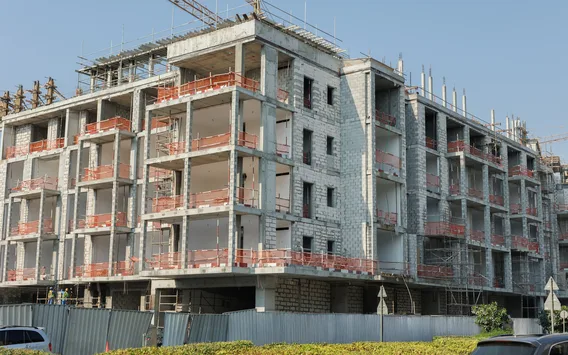
The earthquake this city can actually point to left its buildings standing. What it moved was everything hung on them, stacked against them or holding them level — finishes, stock, mechanical equipment, the rockery and retaining walls that keep a cut site from sliding — and it did that across weeks of repeated shaking rather than in one afternoon. That shape sits underneath the way a Reno building is read.
Nate Jones is a CPCU-designated insurance broker and the founder of Wexford Insurance, LLC and Lessors Risk Guard Insurance. He places lessors risk and
commercial property coverage for owners who lease buildings to commercial tenants,
through a specialty panel writing in 48 states.
Reach him through the quote form or call 317-942-0549.
Last updated · Reviewed by Nate Jones, CPCU
The building stock
Legacy casino and hotel structures downtown, older masonry storefronts, and extensive newer tilt-up warehouse and light-industrial stock on the outskirts.
Compact downtown casino core with arterial retail corridors and large outlying logistics and industrial parks.
What the weather and the ground do here
Seismic exposure in a high-desert basin, with wildfire interface risk and winter freeze.
Set those against each other and the working element turns out to be the mortar rather than the brick. A high-desert year runs the same joint through freezing nights and wide daily swings on very little moisture, so what holds a historic wall together is being conditioned continuously in the long gaps between events, and the wall a shake finds is never quite the wall that was laid. The ownership pattern compounds it. Leasable frontage here divides by address rather than by floor, so an owner is usually carrying a whole small building — its roof, its parapet standing over a public sidewalk, its own street elevation — instead of a share of a large one, and every one of those elements is his alone to keep. Over the prewar brick sits a layer of motor courts, drawn as lodging and long since leased as something else entirely. What an underwriter is working toward across all of it is upkeep, and upkeep on this stock is a history rather than a condition on the day of the survey.
Taken in order, and each pairing is really one question about money. Lime mortar conditioned by a dry, swinging climate in the gaps between shakes — the upkeep history that gets argued alongside the loss. Ground that arrives as a sequence rather than as a single afternoon — how a policy counts one event from the next. A downtown channel whose depth is set by what obstructs it — a flood decision made on more than the flow record. A wind-driven fire in a month nobody calls fire season — values and rents that were never refreshed for it. A whole address going dark when a single tenant leaves — the clause in the owner’s own policy that starts running the moment the last tenant goes. The closing line records that the frame can hold through every one of them while the rent stops anyway.
What the basin, the corridor and the calendar do
Where the cost actually lands
Lime mortar conditioned by the climate between events
Upkeep history, argued alongside the loss
Ground that arrives as a sequence, not as an afternoon
How your wording counts one event from the next
A channel whose depth is set by what obstructs it
Flood coverage bought beyond the flow record
A wind-driven fire in a month nobody calls fire season
Values and rents that do not wait for a season
A whole address gone dark when one tenant leaves
The clause that starts when the last tenant goes
The frame can hold through all of it and the rent still stops.
Nothing on this list requires the building to fail.
The local law that binds you
This is the one instrument on this page written by the city rather than by an insurer, and it earns its place because it works on the same object everything else here does. What turns a corridor building into a municipal problem — a roof let go, an opening nobody has secured, a wall nobody has been up to look at — is close to the list a surveyor walks before a carrier will put a price on it. The municipal file and the underwriting file end up describing one building from opposite ends. That matters most after a loss, when the whole argument is about what condition the building was in beforehand: your own records are the first evidence of it, and a city that has been writing things down is the second, whether or not you were the one who invited the attention.
Abandoned nuisances — owner duty regarding long-vacant buildings and premises
No owner, occupant, agent, person associated with the property or anyone having charge or control of any property, building or premises within the city shall permit or allow the existence of an abandoned nuisance upon any property building, structure, or premises owned, occupied or controlled by him and shall be subject to the remedies and enforcement provisions of this chapter.
This is a nuisance-abatement duty rather than a registration regime. It binds owners and agents of any property, but only once an abandoned nuisance exists.
The other half of this is not about how you keep the building at all. It sits in the policy form you already signed, which sets out what that form does once space stops being used, and the reason that lands hard in Reno is that this city offers no quiet season to leave one in. The fires that have done the most damage in this county were declared in November and in the middle of winter rather than in high summer, because they are wind events rather than cured-fuel events. The flood of record came down on warm winter rain falling into snow. The ground keeps its own schedule and consults nobody’s lease. So an unoccupied stretch is not a pause in the exposure — it is the exposure, arriving in whichever month an owner had privately written off. What your policy does in that stretch is settled by wording most owners open for the first time afterwards.
We did not find a standard fire policy printed in Nevada’s insurance
code. That is a limit on what we searched, not a finding that no such
provision exists — so treat your own policy’s vacancy condition as the
operative text, and read it before a unit goes dark between tenants.
The statute and the exact words where there are any, together with whatever the
research recorded, are on the
Nevada page.
Mixed-use in Reno is most often a habitational floor put over a corridor storefront, or units inserted into brick along the east warehouse spine, where the rail line was the original reason the buildings existed at all. Retail is the arterial run itself — single frontages, separately owned, plus the pads strung along the outer arterials — rather than a leasing plan drawn around anchors. Office splits in a way it does not everywhere: a floor over a shop, a suburban plate out in the south of the valley, and the casino-era towers downtown, which carry their own construction question and their own occupancy question at the same time.
Everything above is local. A coverage line is not — the same form sits in a basin and on a coast and cannot tell the difference. The pages below put the geography back down and take the lines on their own terms:
The last real earthquake here left the buildings up. Why does it still drive the pricing?
Because standing up and staying in business are separate outcomes. The shaking this city can demonstrate was shallow, violent and brief, and it did its damage below the structure: stock off shelves, cracked seams and finishes, mechanical equipment shifted, and the rockery and retaining walls that hold a cut site level. None of that is a collapse. All of it closes a space while it is put right, and all of it lands on the owner rather than on the frame.
Can anyone tell me whether my building sits on the fault or off it?
Not with the confidence owners expect. The Mount Rose fault zone comes into this metro off the eastern flank of the Carson Range as a scatter of overlapping, stepping strands rather than one clean trace, and the mapping is openly unfinished — reflection work along the Truckee puts the system further under the downtown corridor than published mapping showed, and profiles in the south Reno commercial corridor read as faulting with near-surface expression directly beneath the pavement. A placement here therefore prices the basin, not the parcel, and a distance-from-the-fault argument is not really open to you.
The shaking arrived as a swarm rather than one event. What does a sequence do to a claim?
It turns a single question into a repeated one. A swarm-shaped sequence puts the same building through inspection after inspection over weeks, with non-structural repairs restarting each time and tenants deciding to leave part-way through rather than at the start. The live items are how your wording groups shocks into an occurrence, whether a retention can apply more than once across the sequence, and how long the rent protection runs — because the interruption is the length of the sequence, not the length of one shake.
The river has carried more water than it did in the worst flood downtown. Is that reassuring?
No, and it is the most useful thing an owner here can know about water. The deepest flooding on record through the middle of town did not come from the highest flow the gage has measured; an earlier flood carried more water at appreciably less depth. What set the depth was conveyance — bridges, debris, and what has been built toward the channel through the downtown reach. A flow record therefore understates the depth question, and depth is what reaches your floor. Flood sits outside a property form, so it is bought deliberately or not at all.
My building is in town, well away from the brush. Should fire season change what I do?
The season is the part to distrust. As the record set out above shows, the worst of these declarations here did not fall in high summer at all — they are wind-driven events, and wind carries embers a long way past the edge of the vegetation. So the questions worth asking are about the interface at the edge of the developed area, what is stored against your walls, and whether your schedule of values still describes the building.
A storefront of mine has been empty since the last tenant left. What is different now?
Your policy is, before anything else. What a property form does once a space stops being used is set out in the form you already signed rather than anywhere in the state’s code, so read that wording first. What is local is that Reno gives you no season to sit it out in, and that a quiet address on an arterial run is one nobody happens to walk past. So tell your broker the space is empty before the wording tells you, and be able to show that somebody is going through the building while it waits.
Sources
Neither link below belongs to us. One is the city’s own publication of the section quoted above; the other is the Nevada regulator, where a producer’s standing is a matter of public record.
What settles a Reno placement is the building itself — what the walls are made of, what stands over the sidewalk, what the site is cut into, and how much of the address is earning rent this month. With that much in front of us we can tell you what the placement is going to turn on, before anyone asks you for a loss run.